
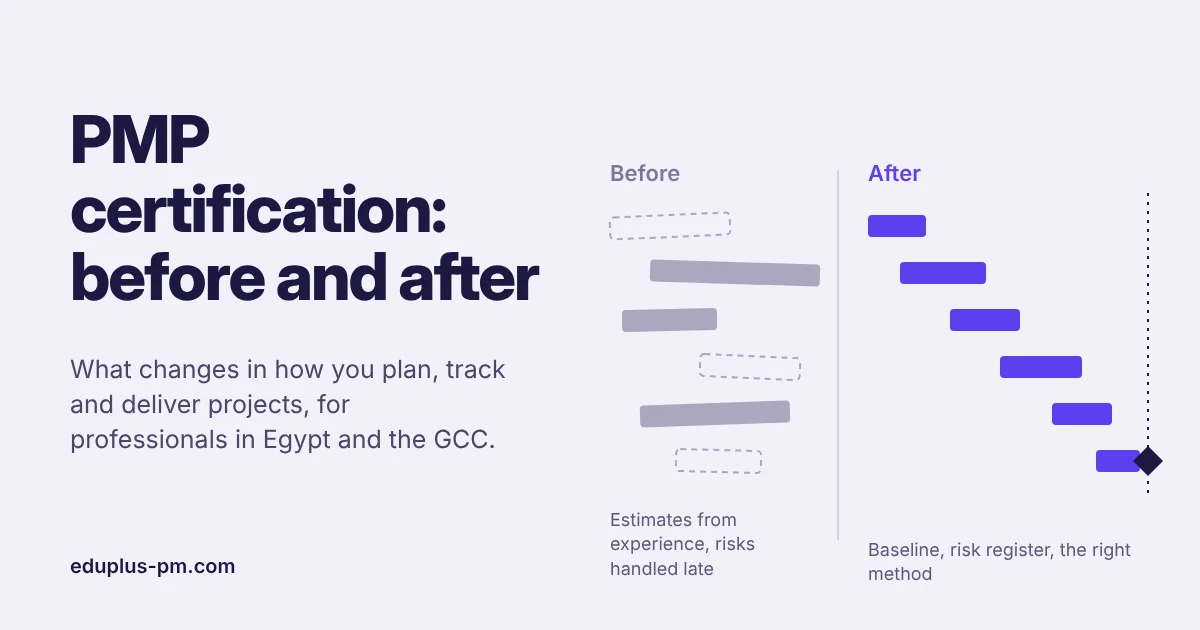
PMP certification is a widely recognised credential for project managers, and for professionals in Egypt and the Gulf it often marks the point where experience becomes a structured, provable skill set. This guide looks at it from the candidate’s side: where you usually start, what the preparation builds, and what you can do differently once you are certified. It reflects the PMP exam update of July 2026.
We will take you on a realistic journey to reveal what a professional’s profile and level look like before obtaining the PMP certification, and how they change drastically after earning it. We will also walk you through the process step-by-step, utilizing specialized training programs updated for 2026, such as the PMBOK 8th Edition course offered by the EduPlus Institute; to help you embark on this path.
Where do most candidates start?
Most people who prepare for the PMP in Cairo, Riyadh or Dubai are not beginners. They are engineers, IT leads, site managers and operations staff who already deliver projects. What they often lack is a shared framework. Typical starting points include:
- Plans that live in a spreadsheet, with no agreed baseline for scope, schedule and cost.
- Risks handled when they become problems, instead of being identified and ranked early.
- Stakeholder expectations discussed informally, so they drift over time.
- One delivery style for every project, whether or not it fits.
You do not need prior PMP knowledge to begin preparing. EduPlus courses start from scratch, although PMI’s experience requirements still apply when you apply for the exam.
Your professional status “before” the PMP certification
Before embarking on preparations for the PMP exam and delving into the body of knowledge provided by the Project Management Institute (PMI), many project managers and engineers find themselves trapped by recurring challenges that hinder their career advancement:
- Falling into the trap of randomness and “firefighting” (crisis management): Before obtaining certification, a manager often relies on personal judgment and immediate, reactive responses whenever a problem arises, this is due to the lack of a structured, methodical framework for managing project scope, timelines, and unexpected developments.
- Difficulty in managing conflicts among stakeholders: Projects often fail due to poor communication or conflicting interests between senior management, clients, and the project team, stemming from a lack of understanding regarding how to effectively engage stakeholders.
- Weakness in financial negotiation and budget management: Engineers sometimes focus exclusively on technical aspects, lacking the ability to calculate value-based delivery or precisely plan for financing and procurement—often resulting in costs that exceed the available budget.
- Salary ceilings and limited opportunities in the Gulf and Egypt: In markets such as Saudi Arabia and the UAE, the PMP certification has become a preferred or mandatory requirement for advancement into senior management roles (e.g., Senior Project Manager or PMO Director). The absence of this credential deprives young, talented professionals of cross-border career opportunities.
How your level changes during preparation
To transition from “task management” to “global professional standards,” it is essential to enroll in a program offered by an Authorized Training Partner (ATP) that incorporates the latest international updates. Such as the EduPlus PMP course (8th Edition), led by project management expert Engineer Amr El-Khadari.
These courses are structured by breaking down the curriculum into three main pillars, designed to hone your skills, from the basics all the way to professional mastery:
- The People Domain: This fundamentally transforms your leadership style; you learn how to develop a shared vision for the team, manage conflicts wisely, and guide members toward maximum productivity.
- Process Domain: Provides you with the scientific tools for planning scope, schedules, quality, and procurement, while integrating cutting-edge AI use cases into project management for 2026.
- Business Environment Domain: Connects your project to the organization’s strategic goals, governance, compliance, and effective navigation of external economic changes.
What you can do after PMP Certification
Once you pass the international exam and obtain your certification, managers and clients will notice a radical shift in your mindset and the way you manage projects. You will be able to:
- Speaking the universal language of project management: You won’t have to rely on guesswork; instead, you will base your work on an international framework (PMBOK) recognized by the world’s leading companies, giving you full confidence when making decisions in front of senior management.
- Delivering projects on time and within budget: possessing the ability to anticipate risks before they occur and to develop contingency plans that protect projects from setbacks or schedule delays.
- Leading multicultural teams (in Egypt and the Gulf): With your deep expertise in leadership and stakeholder engagement, you will be able to lead geographically dispersed teams across the Gulf countries and Egypt with seamless efficiency.
- Multiply your career opportunities and increase your income: This certification opens doors to working with multinational companies in Riyadh or Dubai, or even working remotely for major international organizations, with competitive salaries paid in hard currency.
Requirements and the 2026 exam in brief
– Education: 35 hours of project management education, or an active CAPM.
– Experience: documented experience leading projects. PMI extended the eligibility window to 10 years.
– Exam: 180 questions in 240 minutes.
– Training hours: PMI has announced a planned change to live-training requirements from late Q4 2026, so confirm that your provider qualifies.
Always check the current PMP handbook on PMI.org before you apply.
Preparing with EduPlus
EduPlus is a PMI Authorized Training Partner. It offers two routes, both built on the July 2026 outline:
– PMP Course Online: 20 lessons, 23 quizzes, six full 180-question practice exams, domain-focused practice sets and 52 weeks of access.
– PMP Live Course: 12 online sessions of three hours each, on Mondays and Wednesdays at 7:00 PM local time. The next cohort starts on 30 November 2026.
Choose live if you want a fixed schedule and direct interaction with the instructor. Choose online if you need to study around shifts and travel.
Conclusion
PMP preparation takes sustained effort, and passing is not guaranteed. Plan weekly study time, take full practice exams under timed conditions, and review every mistake by domain. Certification does not replace experience. It organises it.
Written by the EduPlus team and reviewed by Amr El Khodary, PMP Certification lecturer with more than 16 years of project management experience. Last updated: 17 November 2026.